

Introduction
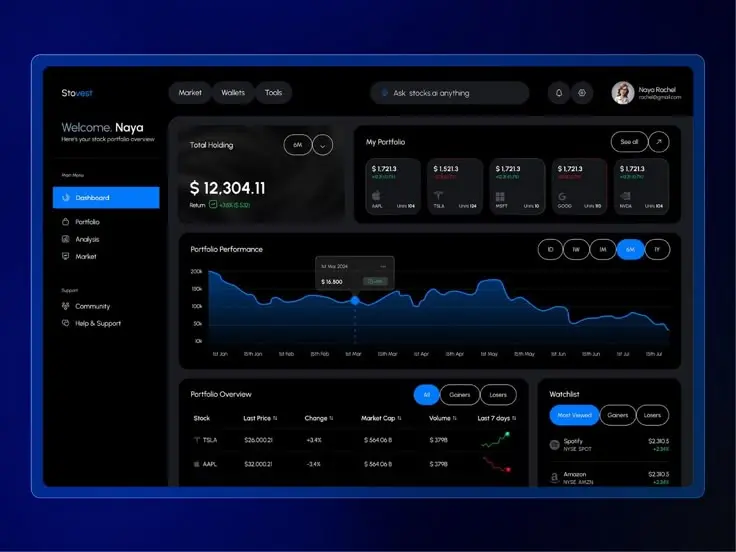
Investing can feel overwhelming, especially for beginners who are trying to track multiple assets, portfolios, and market trends. An investment dashboard is a powerful tool designed to simplify this process. It provides a central location where investors can monitor their financial activities, analyze data, and make informed decisions. With the right features, a dashboard transforms chaotic numbers into clear, actionable insights.
Modern investment dashboards are not just for professionals. Beginners and intermediate investors can greatly benefit from a dashboard that offers intuitive design, accurate data, and customizable options. Features like real-time tracking, performance analytics, and alerts help investors stay ahead of market trends. Additionally, dashboards that integrate multiple investment types—stocks, bonds, mutual funds, and cryptocurrencies—allow for a complete overview of one’s financial health.
Selecting the right investment dashboard requires understanding the key features that make it effective. Some dashboards excel in visualization, others in automation or reporting. In this article, we will explore the essential features every investment dashboard should have, the benefits, potential risks, common mistakes, and expert tips to maximize its use. Whether you are just starting or already managing multiple investments, this guide will help you choose a dashboard that supports your financial goals.
What is an Investment Dashboard?
An investment dashboard is a digital platform that consolidates all your investment information in one place. It provides an overview of your portfolios, showing performance, allocation, returns, and risks. Think of it as the cockpit of your financial journey: it gives you the controls, displays, and tools needed to navigate the markets effectively.
Dashboards vary in complexity. Some offer simple tracking of a few investments, while others provide advanced analytics, predictive insights, and integration with multiple brokerage accounts. Key functions include visualizing your asset distribution, monitoring market performance, and generating reports for better decision-making.
An investment dashboard may also incorporate features like news feeds, alerts, tax planning tools, and scenario analysis. These elements allow investors to react quickly to market changes and plan strategically. Essentially, a well-designed dashboard converts raw data into information that is easy to interpret and act upon.
Why is an Investment Dashboard Important?
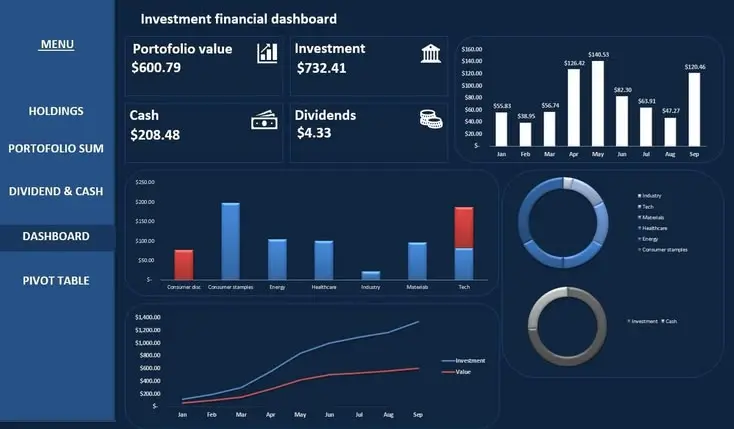
Investment dashboards are vital for several reasons. First, they save time by aggregating all investment information in one place. Instead of checking multiple accounts separately, you get a consolidated view of your finances.
Second, dashboards improve decision-making. By visualizing trends, risks, and returns, investors can identify underperforming assets and opportunities for growth. Real-time tracking ensures you stay updated with market movements, minimizing the risk of missed opportunities.
Third, dashboards enhance portfolio management. They help balance assets according to your risk tolerance and investment goals. Automated tools can suggest rebalancing strategies and notify you of market fluctuations.
Finally, dashboards promote financial discipline. By regularly reviewing performance metrics, investors become more proactive, avoiding emotional decisions and impulsive trades. Overall, a robust dashboard is not just a convenience—it is a strategic tool for long-term financial success.
Detailed Step-by-Step Guide
1. Real-Time Portfolio Tracking
A must-have feature is real-time tracking of your investments. Look for dashboards that provide instant updates on stock prices, bond values, and other assets. Real-time tracking allows you to respond quickly to market changes.
2. Customizable Data Visualization
Charts, graphs, and heatmaps make data easier to understand. Choose a dashboard that allows customization of visual layouts. You should be able to see your portfolio allocation, historical performance, and sector-wise breakdown at a glance.
3. Integration with Multiple Accounts
Your dashboard should integrate seamlessly with banks, brokerages, and crypto wallets. This centralization avoids manual data entry and ensures your portfolio is always up-to-date.
4. Alerts and Notifications
Market alerts and notifications keep you informed about price changes, dividend payouts, or unusual activity. Customizable alerts help you focus on the metrics that matter most.
5. Risk Assessment Tools
Dashboards with built-in risk assessment help identify overexposure or potential vulnerabilities in your portfolio. Tools such as volatility tracking and scenario analysis enable proactive risk management.
6. Performance Analytics
Analytical tools evaluate your portfolio’s performance against benchmarks. Look for dashboards that calculate ROI, CAGR, and asset correlation. Advanced analytics provide insights into both short-term gains and long-term strategies.
7. Tax and Reporting Features
Some dashboards offer tax-related features that simplify filing and reporting. Automatically generated statements, dividend tracking, and capital gains reports save time and reduce errors.
8. Goal Setting and Tracking
Dashboards that allow you to set investment goals make it easier to track progress. You can define short-term, medium-term, and long-term targets, then monitor whether your portfolio aligns with these objectives.
Benefits of an Investment Dashboard
- Consolidates all investments in one place
- Offers real-time insights and tracking
- Enhances decision-making and risk management
- Provides customizable visualizations for better understanding
- Automates reporting and tax calculations
- Supports goal setting and progress monitoring
- Encourages disciplined investing
Disadvantages / Risks
- Reliance on technology may lead to overconfidence
- Data errors or integration issues can mislead investors
- Advanced features may be complex for beginners
- Some dashboards require subscription fees
- Security and privacy concerns with connected accounts
Common Mistakes to Avoid
- Ignoring risk metrics and relying solely on returns
- Overcomplicating the dashboard with unnecessary features
- Failing to regularly update or review the dashboard
- Neglecting diversification insights provided by the dashboard
- Relying only on automated alerts without personal analysis
FAQs
1. Can beginners use investment dashboards effectively?
Yes, many dashboards are designed with beginner-friendly interfaces, providing easy-to-understand charts and automated insights. Beginners should focus on dashboards that emphasize learning and guidance rather than just analytics.
2. Do investment dashboards replace financial advisors?
No, dashboards complement financial advice but cannot fully replace human expertise. They provide data and insights, while advisors interpret complex situations and offer personalized recommendations.
3. Are investment dashboards secure?
Most reputable dashboards use encryption and two-factor authentication to protect data. However, users should always verify security measures before linking accounts.
4. How often should I check my dashboard?
Daily monitoring is ideal for active traders, while weekly or monthly reviews are sufficient for long-term investors. The key is consistency without overreacting to short-term fluctuations.
5. Can dashboards track multiple asset types?
Yes, modern dashboards support stocks, bonds, mutual funds, ETFs, and cryptocurrencies. Integration ensures all data is visible in a single interface.
6. Are there free investment dashboards available?
Many dashboards offer free basic versions with essential features. Paid versions provide advanced analytics, integrations, and customizations for more serious investors.
7. How do alerts help in investment decisions?
Alerts notify investors of price changes, news updates, or threshold breaches. This allows timely action without constantly monitoring the market.
Expert Tips & Bonus Points
- Choose dashboards with mobile apps for monitoring on-the-go.
- Customize alerts to focus on your risk tolerance and priorities.
- Use dashboards to compare performance against benchmarks.
- Regularly export data to review trends over longer periods.
- Take advantage of tutorials and support offered by the dashboard provider.
- Combine dashboard insights with personal research for better decision-making.
Conclusion
An investment dashboard is an indispensable tool for anyone serious about managing their finances efficiently. It centralizes information, provides real-time insights, and supports data-driven decisions. From beginners to intermediate investors, a dashboard simplifies portfolio tracking, risk management, and goal achievement.
Choosing the right dashboard involves evaluating features like real-time tracking, integration capabilities, customizable visualizations, alerts, and performance analytics. While no tool is perfect, a well-designed dashboard can save time, reduce errors, and foster disciplined investing. By understanding and leveraging its key features, investors can stay informed, minimize risks, and make smarter financial decisions.
Investing becomes less intimidating when you have a dashboard that presents information clearly and empowers you to act confidently. Start by identifying the features that align with your goals, customize your dashboard for your needs, and monitor your investments consistently. With these practices, an investment dashboard is not just a tool—it’s a roadmap to financial success.
